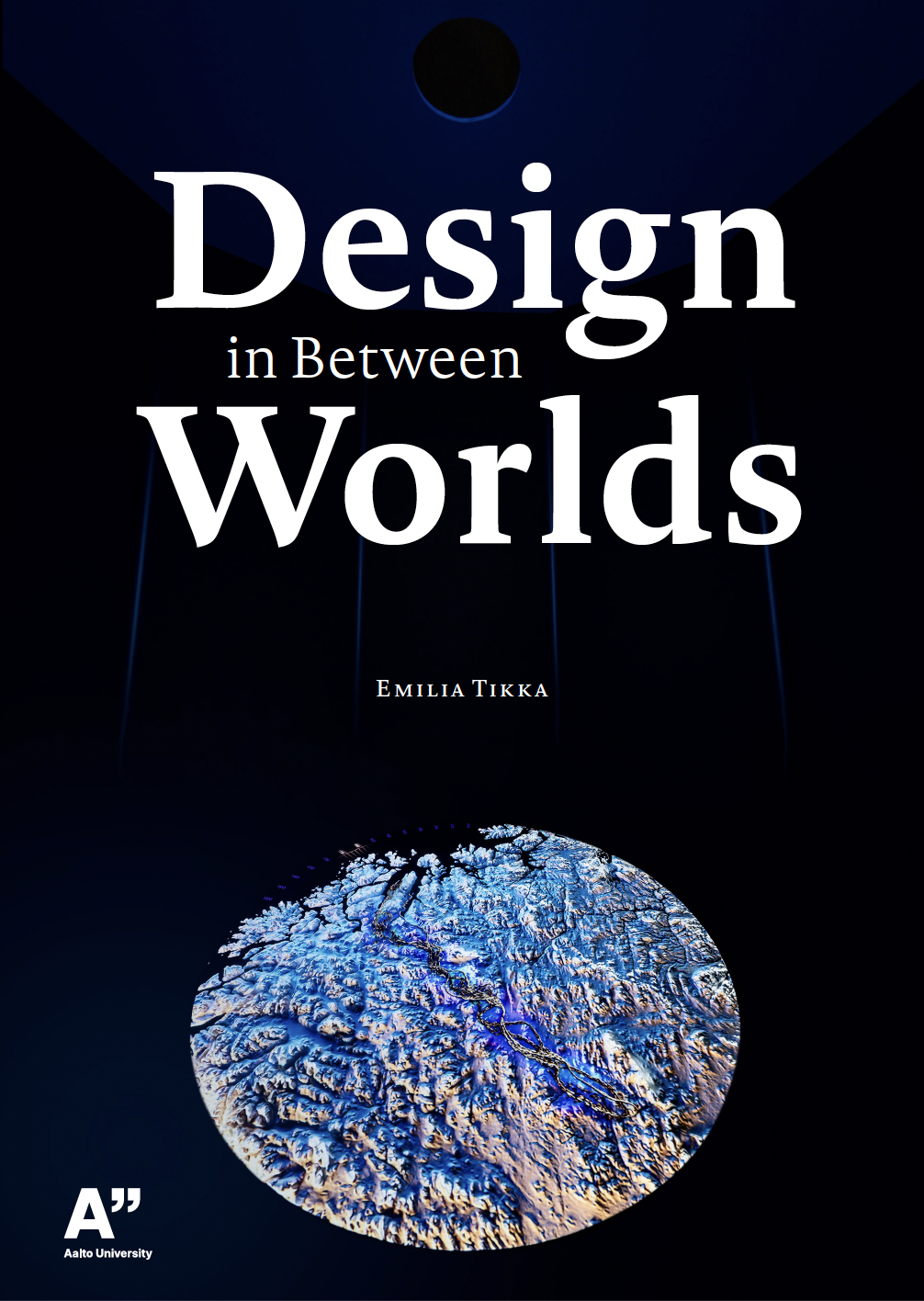
Design in Between Worlds.
Bioscience Imaginaries and Living Relations of Reindeer Worlds
Doctoral thesis by Emilia Tikka, published 2026 as print and open access
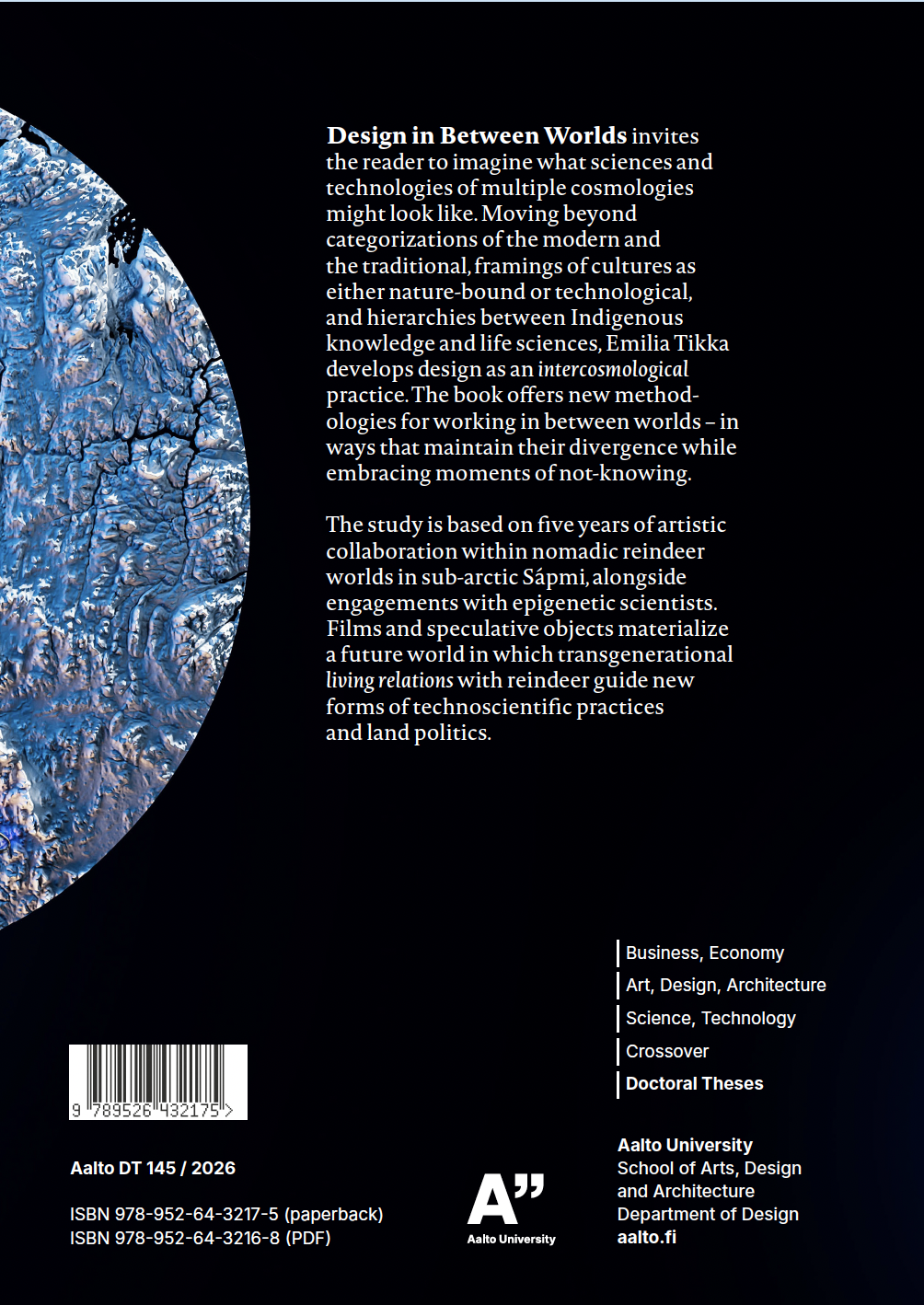
What might sciences and technologies of multiple cosmologies look like? Building on the notion that we no longer live in a one-world world (1), this doctoral thesis argues for moving beyond binary categorizations of the modern and the traditional, framings of cultures as either nature-bound or technological, and hierarchies between Indigenous knowledge and life sciences. The study develops design as intercosmological practice, asking how practice-based research can engage with different knowledge cultures without reducing or translating them into one another.
The study centralizes politics of ontology showing how Western nature-as-universal comes to dominate technoscientific discourse, while other cosmologies and their knowledge cultures are reduced to cultural beliefs. While Indigenous knowledge systems may be recognized as equally valuable to Western sciences, their cosmologies—and thus their understandings of what is or can be real—continue to remain excluded. (2) Drawing on Isabelle Stengers' and Bruno Latour's notion of cosmopolitics, the thesis develops design as an intercosmological practice. (3)
The research was based on five years of artistic collaboration in sub-arctic Sápmi, within nomadic reindeer worlds, working closely with a reindeer herder and his partner. Filmmaking was central to the artistic collaboration grounded in felt realities, oral histories and living relations of reindeer worlds. The co-authored artworks served both as methods of inquiry and as outcomes of the research, materializing situated imaginaries of postcolonial technoscience based on transgenerational relations with reindeer and land. Furthermore, the project engages in dialogue with epigenetic scientists to explore kin relations beyond gene-centered understandings of biological inheritance.
The research also draws on speculative, feminist and decolonial design approaches, anthropological inquiry, and feminist and Indigenous science and technology studies. It conceptualizes speculation as a “gap” between worlds, where different forms of knowledge—such as reindeer cosmology and bioscience—can be held as simultaneously factual within their own terms, enabling dialogue across difference. Rather than seeking synthesis, the approach focuses on collaborating in divergence, where cosmologies, knowledge cultures, and nature–technology relations retain their complexity. The project also reflects critically on power dynamics in collaborations with Indigenous contexts. It argues against pre-framing Indigenous relational worlds as “nature-bound” or interpreting them through Western epistemological frameworks. It emphasizes situated, personal accounts of temporality and kin relations, instead of generalized community narratives showing how this approach can redistribute authorship and forms of knowledge production within collaborative artistic research.
The study also results artworks that materialize stories of multicosmological technosciences, in which transgenerational living relations with the land and reindeer guide novel technoscientific practices and politics of land. The study reveals that epigenetic memories in the biosciences, while grounded in rational scientific practices, also possess a holistic dimension. Moreover, the research positions Indigenous knowledge, frequently characterized as “traditional,” within a trans-categorical context, demonstrating how it can inform and reimagine technoscience worlds.
Abstract References
1 De la Cadena, and Mario Blaser, eds. A World of Many Worlds. Duke University Press, 2018. Law, John. “What’s Wrong with a One-World World?” Distinktion: Journal of Social Theory 16, no. 1 (2015): 126–39. 2 Savransky, Martin. Around the Day in Eighty Worlds: Politics of the Pluriverse. Duke University Press, 2021. 3 Latour, Bruno. “Whose Cosmos, Which Cosmopolitics?” Common Knowledge 10,no. 3 (2004): 450–62. Stengers, Isabelle. Cosmopolitics. University of Minnesota Press, 2010.
Doctoral Program:
Aalto University, School of Art, Design and Architecture
Grade:
Pass with Distinction
Thesis advisors:
Professor Mianna Meskus, Tampere University, Department of Social Sciences
Professor Julia Lohmann, Aalto University, Department of Design
Thesis Supervisor:
Professor Guy Julier, Aalto University, Department of Design
Pre-examiners:
Professor Shaowen Bardzell, Georgia Institute of Technology
Professor Åsa Ståhl, University of Gothenburg
Defence Opponent:
Professor Åsa Ståhl
Collaboration Partners:
Oula A. Valkeapää and Leena Valkeapää.
The project has been additionally consulted by various bioscientists from fields of epigenetics and climate research.
Research Funding and Grants:
Kone Foundation, Aalto University, Tampere University
Thesis Format:
Monograph, 303 pages in English
ISBN:
978-952-64-3217-5 (paperback) 978-952-64-3216-8 (PDF)